中文简体
中文简体 Search
 Contact

Consultation/Cooperation
010-68711086HR Line
010-62137913-8605 Publish Date:
 Visits:
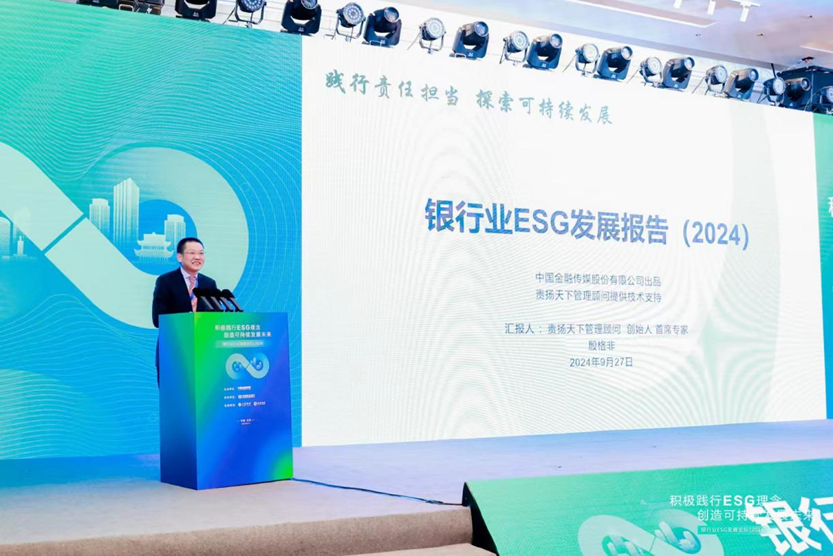
On September 27, On the Development of ESG in Banking Industry (2024) (hereinafter referred to as the Report) was officially released at the “ESG Development Forum of the Banking Industry 2024” to reveal the above findings.
The Report was initiated
by China Financial Media Co., Ltd., with full technical support
provided by GoldenBee Consulting. It aims to systematically show the ESG
development of China’s banking industry, objectively evaluate its
current development level, and continuously track its future progress.
It intends to further promote the better implementation of ESG-related
policy requirements in the banking industry and improve its ESG
performance through the accumulation and sharing of ESG practical
experience.
At the release of the Report,
Yin Gefei, Founder and Chief Expert of GoldenBee Consulting, mainly
shared his insights on ten major findings and trends of ESG development
in China’s banking industry.
01
The level of ESG development in the banking industry is at
"catch-up" stage, with significant improvement of its ESG performance
compared with the previous year.
Considering
that the range and indicators of the control sample are consistent with
those in 2023, the ESG score increases by 10.73% compared with the
previous year, with an increase of 25% in the environmental score, an
increase of 16.67% in the social score, and an increase of 4.35% in the
governance score. Compared with 2023, the scores of the banking industry
in various topics are basically increasing.
02
The ESG scores of large state-owned commercial banks, joint-stock
commercial banks, city commercial banks and private banks have all
increased year on year, and the level of ESG development of rural
commercial banks included in the evaluation for the first time is at the
"catch-up" stage.
Compared
with 2023, there are significant increases in the scores of large
state-owned commercial banks on such topics as green finance, transition
finance, supply chain sustainable management, inclusive finance, and
employee rights and development.
There
are significant increases in the scores of joint-stock commercial banks
on such topics as green finance, climate change, biodiversity finance,
supply chain sustainable management, and inclusive finance.
Urban
commercial banks have shown significant improvements in
scores for green operation, green finance, data security and privacy
protection, and financial consumer rights protection.
Great improvements
were observed in the scores of private banks for green operation,
climate change, data security and privacy protection, and ESG
transparency.
03 ESG
performance of listed banks have basically achieved
"excellence" stage, with significant improvement of its performance on
biodiversity finance, sustainable supply chain management and inclusive
finance, especially on technology finance and digital finance.
In
2024, ESG performance of listed banks basically achieved "excellence"
stage. Compared with 2023, its score on biodiversity finance increases
by 41.92%; that on sustainable supply chain management by 23.97%; and
that on inclusive finance by 20.75%.
Listed
banks have played a leading role in technology finance and digital
finance with outstanding performance. As estimated, 24.00% of the sample
banks disclose balances of loans for strategic emerging industries, of
which listed banks account for more than 70%. In addition, the average
investment of listed banks in financial technology reaches CNY 6.624
billion, accounting for 3.40%, which shows that listed banks have
continuously increased their investment in digital transformation and
technological innovation, laying a solid foundation for promoting the
high-quality development of the financial industry.
04
The ESG performance of non-listed banks is at "development" stage, with
significant improvement on green operation, climate change, data
security and privacy protection, and ESG transparency.
In
2024, the overall ESG performance of non-listed banks included in the
evaluation is still at "development" stage, but their ESG risk and
opportunity management ability is lower than the overall level of the
banking industry.
Compared
with 2023, the score on green operation increases by 67.54%; that on
climate change by 116.34%; that on data security and privacy protection
by 68.39%; and that on ESG transparency by 98.21%.
05
The banking industry has achieved outstanding performance in green
finance, in which large state-owned commercial banks have significantly
improved their practices.
The
average score of the sample banks on green finance is the highest among
the scores on environmental topics, and that of large state-owned
commercial banks reaches 0.88, with a year-on-year increase of 24.60%,
which indicates that these banks have made remarkable progress in
promoting the development of green finance.
06
There is significant year-on-year improvement of the performance of the
banking industry on climate change, biodiversity finance and green
operation.
The
scores on green finance, climate change, biodiversity finance and green
operation increase by 11.75%, 31.97%, 45.55% and 26.13%, respectively,
on a year-on-year basis, and the disclosure rate of three-level
indicators under each topic also increases compared with the previous
year.
07
The banking industry has improved its performance on inclusive finance,
with large state-owned commercial banks and joint-stock commercial
banks performing well in this field.
From
2021 to 2023, the balances of inclusive loans for small and micro
enterprises showed an upward trend year by year, while the interest rate
of inclusive loans showed a downward trend. This indicates that the
banking industry has not only enhanced its support for small and micro
enterprises, but also effectively reduced the financing cost of these
enterprises by lowering the loan interest rate, contributing much to
their development.
Large
state-owned commercial banks and joint-stock commercial banks have
achieved outstanding performance on inclusive finance, with their
average inclusive finance score close to or above 0.70, reaching its
excellence.
08
The banking industry has significantly improved its performance on data
security and privacy protection and financial consumer rights
protection.
The
banking industry attaches more importance to customer privacy and bank
data security. As estimated, 58% of the sample banks have disclosed
their protection measures for customer privacy, and the number of the
banks increases by 24.2% year on year. Moreover, 56% of the sample banks
have established their data security management systems, and the number
of the banks increases by 22.9% year on year.
There
is significant improvement of performance on financial consumer rights
protection. Nearly one-third of the banks have disclosed their customer
satisfaction, and the proportion of customer satisfaction in the range
of 90% to 100% increases by 2% compared with the previous year. More
than half of the banks have disclosed their measures for
sustainable/responsible product promotion and consumer education, with a
significant year-on-year increase.
09
The banking industry emphasizes on risk control and the construction of
business ethics, and there is generally a downward trend in the
non-performing loan ratio and an upward trend in the capital adequacy
ratio.
The
banking industry values risk control and the construction of business
ethics to ensure the stability and compliance of the financial system
through institutional improvement and management enhancement. Most banks
have formulated strict anti-money laundering policies and integrity
systems to strengthen their risk management and crisis response
mechanisms, while improving employees’ professional ethics through
inspections and anti-corruption education.
Among
the sample banks, 89% have disclosed their non-performing loan ratio,
with a year-on-year increase of 0.27% in the disclosure rate, and the
non-performing loan ratios of most banks are lower than 1.7%. Besides,
90.5% of the sample banks have disclosed their capital adequacy ratios,
which are all higher than 9%. Influenced by the decline in
non-performing loan ratio and the increase in capital adequacy ratio,
the banking industry has conducted sound preliminary work in risk
management and capital replenishment to safeguard the stable operation
of the financial system.
10
The banking industry emphasizes on the improvement of ESG governance
structure, in which a few pioneering banks have formulated their ESG
strategies, and there is significant year-on-year improvement of ESG
transparency among non-listed banks.
The
banking industry attaches more and more importance to ESG governance,
with significant year-on-year increases in the scores on ESG governance,
ESG transparency and ESG strategy. A few pioneering banks have taken
their lead in formulating a clear ESG strategy and actively promoting
the development trend of green finance. The disclosure rate of ESG
reports of listed banks reaches 100%, while that of non-listed banks
increases by nearly 40% on a year-on-year basis.
Based on these findings, the following two suggestions are proposed in the Report:
First,
the sustainable development system of the banking industry shall be
established in an all-round way. It is particularly necessary to take
ESG evaluation as an important tool to influence the management and
practices of sustainable development.
Second,
the sustainable development path of the banking industry shall be
followed in multiple dimensions. It is necessary to promote the
integration and innovation of ESG governance and strengthen the capacity
building of ESG supervision and management executives; to encourage
more banks to strengthen the formulation and execution of ESG strategy;
to strengthen risk and opportunity management, integrate ESG into the
risk management system, and enhance the management and control of green
finance business risk and daily ESG risk; and to develop new products
and services around five major finance articles in an innovative manner
to promote sustainable economic and social development.
As
introduced below, the “ESG Development Forum of the Banking Industry
2024” was hosted by China Financial Media Co., Ltd., and co-hosted by
China Minsheng Banking Corp., Ltd. Guest representatives from government
departments, banking and non-banking institutions and technology
companies had in-depth discussions and exchanges around topics such as
“Interpretation of the Spirit of the Central Financial Work Conference:
How to Do a Good Job in Green Finance”, “Interpretation of the Guidelines for Green and Low Carbon Transformation Industries”,
“ESG Development in Globalization” and “Climate Transformation and
Carbon Finance Practices”. Reports on other ESG-related topics and
typical practice cases in the banking industry were also released at the
forum.